The Mothers of the Disappeared, Witnesses to Violence
Meltem Ahıska
Upon starting to write on motherhood, violence and politics, an essay of Nathalie Sarraute, the French writer who is especially known for her experimental books and articles on language, came to my mind. In this essay, which has the German title “Ich sterbe”, she describes a moment of the Russian writer Chekhov, on his deathbed in a hospital in Germany. Chekhov, who is also a doctor himself, upon understanding that he is about to die, straightens up and tells the doctor – not in his own language, but in German – “Ich sterbe”, which means “I’m dying.” According to Sarraute, this gesture carries the meaning of trying to own up to his own death, with all its weight. If he had said that he was dying in Russian, to his Russian wife sitting next to him, how very much lighter it would all have been.
How very often we tend to use this word in our daily lives… To die of laughter, to be dead tired… Oh, I’m dead… But Chekhov has, as a doctor himself and in the language of the doctor in front of him, tried to face up to this moment with all its horror and, with his last drop of will power, express this very horror in words. An effort which is pitiless against himself and equally futile, but understandable… Just as death becomes mute and technical by being pushed into hospital corners and distanced from its own rituals in our modern society, the violence which tears the symbolic order into pieces stands at the boundaries of words, of language, as a social phenomenon. Many events and periods based on violence which have happened and are still happening in the history of Turkey, such as torture, disappearances, massacres and forced immigration are still not able to find a total response in the political language. They lose their horridness within the routine of the everyday or through political slogans which destroy singularity. Being witness to social violence is mostly delayed, fragmented, estranged. Even so, we may think of being witness to violence as a form of subjectivity.
Both perceiving and dealing with violence are genuinely difficult. First and foremost, the ideological setup of the ‘modern democratic society’ preaches that violence is always accidental and out of ordinary. It is assumed that the body of laws and rules purges the society of violence and monopolizes it in the hands of the state. The violence used by the state has been transformed into a problematic of ‘security’. Thus, the consideration and control of the violence within the society becomes, in and of itself, a means of establishing sovereignty over the society. Even though this ‘democratic’ violence policy, which has been formed and justified in Western societies, has many ‘exceptions’, this has mostly remained invisible in political theory. The forms of establishing sovereignty based on open violence used by many European societies in their colonies, methods which have violence towards foreigners and immigrants at their core, concentration camps – as maybe the most overt example of this – all continue to remain as the law-making ‘exceptions’ of the violence of the state. However, on the other hand, as Agamben argues, exceptions are gradually becoming rules; ‘camps’ are becoming the dominant style of sovereignty in today’s world. The term ‘deep state’, which describes the murky relationship the state has with law and violence in Turkey, may also be examined from this perspective; it may be considered as a historical and definitive dimension of sovereignty instead of pointing at only a period and certain groups. When looked at from this perspective, one must see the systematic nature of ‘disappearances under custody’ and their function within the structure of sovereignty, just like many other forms of violence which keep the law in place by transgressing it. In any case, just as I mentioned previously, it is not at all easy to perceive violence, to voice it and to develop policies against it. As Schmidt discusses, the tradition of Western politics, ultimately bases itself upon a separation of friends and foes and a formation of alliances within this context. However, this policy of alliances is mostly powerless and helpless against this ‘fire’ – if this metaphor is indeed appropriate – of violence which destroys the symbolic boundaries between ‘I’ and ‘the other’, which utterly devastates the existing meaning maps. I believe, conceiving of a political style which may break the power of violence by being witness to it remains before us, as a dire need.
The Disappeared and Their Mothers
In this article I wish to draw attention to the political quality of a reaction coming from the social positions of womanhood against another systemic violence, which is not at all independent from and actually intertwines with violence against women – of which every example is spine chilling. My examples will be from the mothers of the disappeared. My basic question is, how come ‘motherhood’, which is defined through its function of ‘care’ in the private space, can be transformed into a political subject who witnesses a totally strategic form of violence like ‘disappearance under custody’? First of all, one must look at how the position of ‘motherhood’ is defined and experienced within the society. The clash between the definition and the practical context may begin giving us clues to the politics of motherhood. Just like in other societies, motherhood is an exalted position within our society. First and foremost the discourse of nationalism invests upon motherhood; ‘the mothers of the nation’ are holy; they are held in high esteem. Many other discourses, such as the market and modern life, also pick mothers as their target audience. Key terms in the definition of motherhood are self-sacrifice and altruism (self-abandonment). On the other hand, mothers, being women themselves, take their fair share of the misogyny rampant within the society. As we all know, there exists a very widespread and systematic misogyny within the society. (How infinitely ironic it is that feminists are commonly blamed for misandry in the public sphere.) For instance, on the internet site of the kadın kurultayı we keep reading news about women who were beaten, injured, murdered, tortured every day, all over the country (and not just in the East! ) Many of these are either mothers or mothers-to-be.
Women and Violence
However, it is quite clear that we will not be able to preserve women’s loving and kind nature, their love towards peace or their natural power against this deadly, widespread violence targeting them. Just like every oppressed group, women also apply certain tactics in order to free themselves from the oppression they face. They, at times, adopt degrading and belittling women of a lower status than themselves, deceiving and double-crossing each other, fitting in with the existing hegemonic power patterns in order to guarantee their own ‘chosenness’ as survival methods, either consciously or unconsciously. This is not new to any of us; we run into innumerable examples of this in our own lives as well as in the discussions held in the kadın kurultayı. It s clear that we can not say whether women are naturally good or bad; since, ultimately, their subjectivities have been shaped within the power relations in the society. If we are to take this statement and return to the issue of motherhood, violence and politics, I wish to point out a power women may hold due to their being closely acquainted to violence within the social formation mentioned above, while they are also, quite contrarily, associated with the duty of ‘care’. Within this frame, we may take the concept of ‘care’, which has been trapped inside the home, made into the duty of women and is becoming more and more privatized within a certain fraction of the society, and rethink it with all of its oppositional and defiant meanings for the whole the society.
Infinite and unconditioned ‘care’ for another is seen as the one and only foundation of ethics in the philosophy of Levinas. Answering the call of the other, who cannot be reduced or generalized, and keeping that other alive is defined as the greatest possible responsibility by Levinas. This mindfulness and care in the foundation of this statement by Levinas, who was actually trying to give an ethical reaction to the Holocaust, the great horror which shook the very roots of European humanism, takes its inspiration from the unconditioned care towards the home and children motherhood entails. However, for Levinas, who could not avoid reproducing the hierarchies of the gender regime, motherhood remains apart from the ethics of the call to honesty and justice, as a separate universe. Even though mothers do provide a warm and loving hug, they do not exhibit an ethics based on responsibility.
In Turkish, there are two words for care, özen and bakım, and these carry quite different connotations. Özen has ethical and emotional connotation; however, when it is carried into the sphere of material practices and gendered, we see that its social counterpart becomes bakım. Within the gender regime we live in, isn’t motherhood defined through such a concept of care, that is, isn’t it defined through bakım? The mother must demonstrate unlimited self-sacrifice by leaving her own self aside completely for the bakım of the home, family and children. Above all, she must at all costs answer her children’s call and try to keep them alive under all conditions. I believe it is not necessary to say how impossible it is for this ideal to come true. As long as the duty of bakım is given to women only, the emotional and material economy within the family remains based on the exploitation of women, on their being kept under pressure and on violence, women’s trying to show this özen and bakım, this care, which is expected of them, will actually come to signify their acceptance of the pressure placed upon them. Thus, within feminist literature the bakım within the family is associated not with özen (care) and ethics as is in Levinas’ philosophy, but with the invisible and unreciprocated labour of women, with exploitation and pressure. The idea that bakım must have some kind of recompense brings the demand for the recognition of women’ labour in order for its reproduction and also the demand that their labour finds meaning and response within the general economy. However, on the other hand, paradoxically, this estranges the concept of care, of bakım; it makes it conditional. The most evident example of this is the transformation of bakım, of care, into a service which can be bought and sold, for upper-middle class women. Just like the baby-sitter or nanny, the sick-nurse and the cleaning-lady at home… This situation, which frees the women who are the ‘employers’, also creates a mass of working women who are obliged to do the ‘caring’ job, that is, bakım. Here my aim is not to embark upon the class differences between women, which is an issue into which Aksu Bora delves quite deeply in her book. I solely wish to emphasize that the ideal of care, of bakım, which defines women and especially mothers, becomes completely devoid of all meaning under this capitalist and gender regime, based on violence. “Mothers who care…” This phrase goes no further than becoming an empty slogan for advertisements. Yet, when the concept of infinite and gratuitous care is carried onto the societal level, when it is considered as a state of mindfulness towards the world and life, we see that bakım, which has become identified with motherhood, may emerge as a form of being witness to death and violence. Argentina’s Mothers of the Plaza del Mayo or the Cumartesi Mothers in Turkey have transgressed the boundaries of womanhood and motherhood in the private sphere, have even neglected their ‘duties’ in this area and have come out into the public sphere. In doing so they have given the concept of bakım, care, a brand new meaning, both politically and ethically. In a world where consuming wars through newspapers and televisions, destroying groups of people under the stamp of ‘terrorist’, walking past pain and poverty without even bothering to take one look has been gotten used to and normalized, the mothers of the disappeared have tried to translate motherhood into another language and give voice to this horror, just like Chekhov’s saying “I am dying” in a language the doctor could understand while on his death-bed.
‘Losing’ the ‘enemies of the regime’ instead of openly murdering them is a very conscious method of violence formulated with the help of the science of psychology. The most distinctive characteristic of this method of making people disappear, which has been carried from the Nazi Germany, to Chile, Argentina, Iran and many other countries and applied in a systematic manner in these many places, is that it ignores a person’s existence, the very fact that a person has lived. It aims to weaken the relatives and family of the person who has disappeared by creating a hazy fog around the word ‘lost’ and therefore leaving these relatives in a completely ambiguous and desperate situation. The psychologically most tragic part of the strategy of making people disappear is that it gives the duty of ‘killing’ these ‘lost’ people to their relatives and loved ones. The announcement that a person has disappeared ignores both the life of that person and the ending of this life; and does so in a very blunt manner (as is evident in the blatant contradiction within the term ‘lost under custody’). In doing so, it imposes the absolute power of the sovereign. You are forced either to accept and therefore kill your own relative, your own loved one yourself, or to suffer the psychological torture of remaining within ambiguity throughout your life.
Mothers Who Have Transformed Their Subjectivities
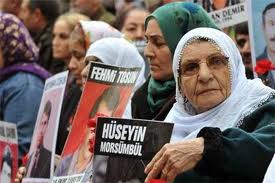
When the relatives of the disappeared came out into plazas, piazzas, places, centers, squares, etc., when they attempted to embrace not only their own children or relatives, but all those who have ‘disappeared’, when they added a social dimension to the idea of infinite and unconditioned care coming from motherhood (even if in different contexts, for different time periods and with different effects) they managed to become powerful political subjects. As has been mentioned in certain books and narratives written on the mothers of the disappeared, it cannot be a coincidence that this form of opposition and defiance which has carried women into the public sphere by transforming their own subjectivities and has opened the way for a political solidarity to them, has been created by mothers. It is interesting to realize that men and fathers have greatly remained in the background throughout this process.
In Argentina, in the period right after the military coup when many people could not dare step out into the street, mothers who had no political experience whatsoever began gathering in the Plaza del Mayo and they have led a movement which has continued up until our day. In Turkey, immediately following the military coup first the mothers of those who were arrested and then the mothers of those who disappeared sprang into action. These people managed to open up an important space for opposition against forms of violence like ‘torture’ and ‘disappearance’ which aim at destroying lives. Owning up to the ways in which women, who know violence quite well, have taken their duty of bakım, of care, which has been shaped within the violence in the family and have universalized it against violence within the society, within feminist politics and beginning to think upon these seems to be, I believe, very important.
From Amargi- Issue 2