Etiketler: articles
Politics of Victimhood or Freedom

Pınar Selek
The feminist network of the European Left (EL Fem) organized a European wide conference in late 2006. This conference, which was made in Italy with the participation of various feminist activists and politicians, was not really heard in Turkey. It tells us a lot about women’s movement and left in Europe and also provides us with a picture -even though a rough one- of our relation with victimhood. That’s why I’ve started my paper with it.
The aim of the conference was to bring out a plan for an international campaign against violence. For this purpose, developing a common perspective towards violence and specifying the primarily important subjects for the campaign was targeted. But the conference did not produce such an outcome.

Fear and Politics

Zeynep Direk
Perhaps, as modern ideas have taught us, not a single discourse is void of rhetoric and even on the basis of the deepest, the most intertwined discourses the inevitable presence of metaphors is encountered. Although it is possible that philosophical discourse may avoid becoming some sort of pedagogy, psychagogy, demagogy; politics essentially compound of nothing but those components. The aim of pedagogical, psychagogical, demagogical discourses is to betray the child, the soul, the akin, their own people, by positioning themselves against them as a knower to reveal a truth they are assumably unaware, and ultimately to stimulate them to protect certain localities of power. Communicating an established ‘reality,’ which is no way accurate and whose proof is incomplete, the objective of the opinion leadership which attempts to obtain the approval of its peoples’ free will is to demolish the freedom of those being asked for approval and to use them as a means. Rhetoric, in this sense, is not a threshold experience of reason, which desires to utter reality and which experiences its own limits, but is a hidden violence.
From Literature to Life: Turning into a Writer
Sezer Ateş Ayvaz
Translation: Türkan Mamur; Editing: Nilay Erten
As Pen women writers committee Müge İplikçi, Nazan Haydari, Nalan Barbarosoğlu, Karin Karakaşlı, Özlem N. Yılmaz and Sezer Ateş Ayvaz, we planned a series of activities when we met in 2007 September. We needed to survey our women writers from literature to life to make their works and languages visible. This journey was toward reconstituting our social history with what women writers inspire and keeping our memories fresh. Women writers were in a life that requires struggle in many fronts, and in every era they tired to generate writing that complicates and puts their lives to a great deal of trouble. The masculine context wanted to render women writers “invisible” or “weak” in the canon of literature. We needed to point out both their lives and works.
No Place Left in the Cemetery of Fallen Women

Gamze Göker
Some say that certain social issues proliferate when those issues become widely spoken about in the media. Some issues, on the other hand, seem like they have proliferated, though they have not, due to their appearance in the media. While the bag snatching incidents, for instance, seemed to have incredibly increased before, almost no events seem to have taken place after the new amendments done in the Turkish Penal Code. The incidents, however, just lost their allure for the media, but we know that they still happen and maybe increasingly so.
Trusting Action
Aksu Bora
When we are trying to understand the adventure of feminism since 1980, we often divide the era simply into periods: the 1980s – excitement, radicalism; the 1990s – institutionalization, becoming commonplace, acceptance; and the 2000s – project fetishism. Drawing a schematic design is always appealing; people feel as though this establishes control leverage over the question. However, the issues are usually too sophisticated to be placed in such a schema, especially if we are talking about feminism, which is a complicated, multi-component movement in constant change. Even though the radicalism, institutionalization, project fetishism schema points out some truths, it masks more than it explains because it attempts to analyze sophisticated issues in a superficial and simplistic manner.
The Mothers of the Disappeared, Witnesses to Violence
Meltem Ahıska
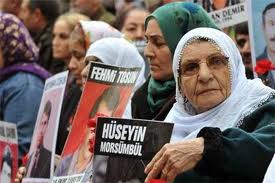
Upon starting to write on motherhood, violence and politics, an essay of Nathalie Sarraute, the French writer who is especially known for her experimental books and articles on language, came to my mind. In this essay, which has the German title “Ich sterbe”, she describes a moment of the Russian writer Chekhov, on his deathbed in a hospital in Germany. Chekhov, who is also a doctor himself, upon understanding that he is about to die, straightens up and tells the doctor – not in his own language, but in German – “Ich sterbe”, which means “I’m dying.” According to Sarraute, this gesture carries the meaning of trying to own up to his own death, with all its weight. If he had said that he was dying in Russian, to his Russian wife sitting next to him, how very much lighter it would all have been.
How very often we tend to use this word in our daily lives… To die of laughter, to be dead tired… Oh, I’m dead…
Anxiety in the Public Sphere of Turkey

Nükhet Sirman
This year the concept of ‘public space’ has been at the top of the agenda in Turkey. Along with state offices, streets and even places the President of the Republic has appeared in have been defined as public spaces. This definition has functioned as the final link in a chain of precautions limiting the movement space of women wearing headscarves. However, at the same time, it also became a means of questioning the meaning of “public space” especially in the socio-political context of Turkey. Thus, the question, which has long been asked by feminists both in Turkey and elsewhere in the world, has begun weighing on the minds of political actors as well.
No Political Symbols Left, What About Role Models?

Hidayet Tuksal
One of the most inauspicious discussions of the latest years, the veiling bans, and the tension caused by these bans have been appraised differently by various groups. Interestingly, there are sides of this subject and in most of the cases, the person talking about the subject bears no relation to the experience of veiling. While the politicians, the academicians or the breaucrats talk most about the subject, the aggrieved people of the problem are made to talk least in media. Veiling bans is such a subject that the agents of the problem is objectified, instrumentalized, incorporated.
The Background of the “Problem”
From the beginning of our westernalization adventure, the reference to the “other” to be exceeded by the well-educated, well-equipped, occupied type of woman -in a sense, carrying the image of westernalization and modernization- was symbolized by the humble, relatively less-educated (or not educated at all), traditionally veiled type of woman.
Projects: The New Context, The Old Problems

Aksu Bora
I remember we brought up and discussed the question of ‘equality or freedom?’ about fifteen years ago, as a slightly hypothetical issue. It was one of the ‘free’ agenda topics of the Persembe Group and someone from this group had brought up the aim of ‘becoming equal to men’ for discussion, also blending it with the whole issue of ‘difference’ and being different from each other. Another person from the same group had proposed the concept of ‘freedom’ instead of ‘equality’ to think in terms of… At that time, this discussion had seemed quite mind opening to me, but it was also very abstract. I could never have imagined that one day this discussion would gain a quite concrete, actual and urgent political significance.